As AI training clusters scale to thousands or even tens of thousands of GPUs, the network fabric becomes just as important as compute power. Every generation of GPU, from A100 to H100 to B200, drives higher east-west bandwidth requirements inside the data center, forcing operators to choose optical modules that balance reach, cost, power, latency, and operational simplicity. Among the available 800G options, including DR4, 2×FR4, and LR4, the 800G FR4 module has quickly emerged as the preferred solution for modern AI clusters. Its combination of four-wavelength architecture, moderate reach, and efficient PAM4-based signal processing makes it the “sweet spot” for GPU-to-GPU and rack-to-rack interconnects.
The Advantage of the Four-Wavelength FR4 Architecture
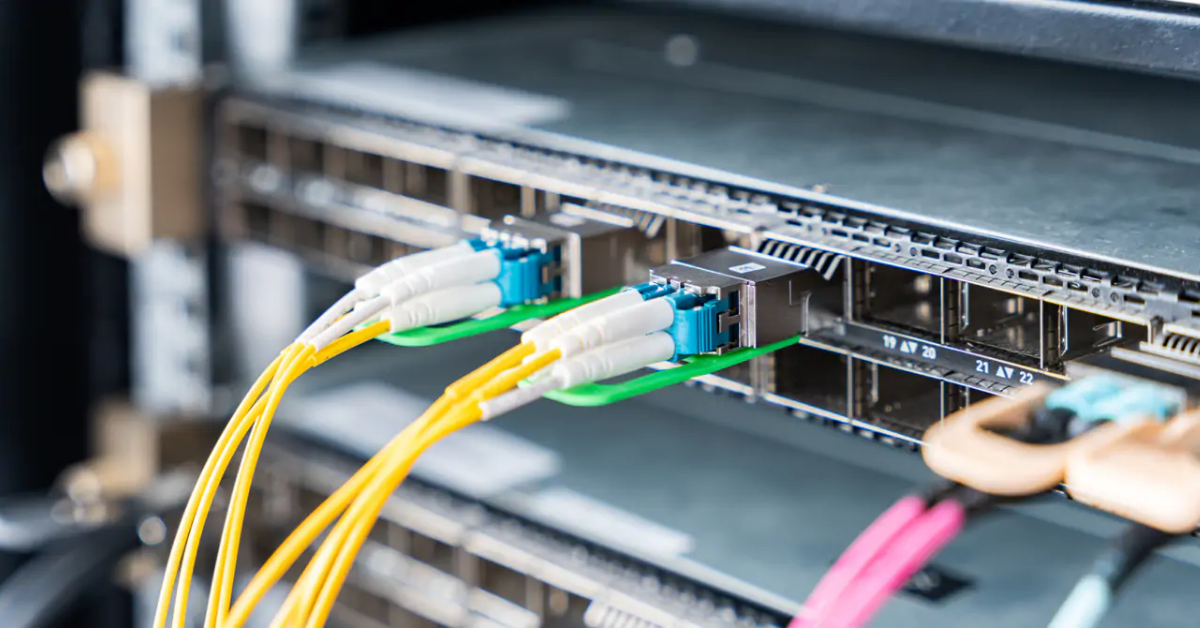
Unlike DR4, which uses four parallel fibers for both transmit and receive, 800G FR4 uses four wavelengths operating over a duplex pair of single-mode fibers. This wavelength-division design offers significant advantages for AI workloads that rely heavily on east-west traffic. AI clusters often require dense fiber routing, predictable link behavior, and maximum port utilization; FR4’s ability to deliver 800G over two fibers simplifies cabling, reduces patch-panel density, and enables far cleaner rack layouts.
The four-lambda architecture also reduces the physical constraints of ribbon fiber management found in DR4 deployments. With fewer fibers to manage, operators can achieve higher rack port density, smoother airflow, and more flexible cluster topologies. This has a direct impact on GPU cluster reliability, especially in large-scale AI pods where thousands of links must be deployed with precise cable organization.
PAM4 + DSP: Optimizing Latency and BER for GPU Fabrics
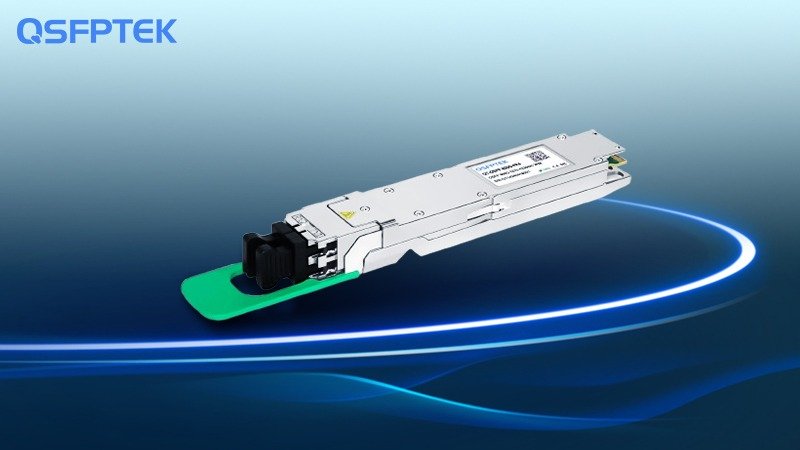
800G FR4 relies on PAM4 modulation combined with advanced DSP equalization to deliver high-speed transmission across 2 km. For AI clusters, this matters because GPU fabric protocols, such as NVLink, RoCEv2, and custom vendor interconnects, are extremely sensitive to bit error rate and micro-latency variation.
While PAM4 inherently carries more noise than NRZ, modern DSP architectures in FR4 modules provide strong pre-FEC and post-FEC error correction with tightly controlled power budgets. The result is a stable BER profile that maintains reliable packet delivery even during training bursts. Importantly, the DSP processing latency in FR4 modules remains well within acceptable limits for AI workloads. Compared with 2×FR4 architectures, where two independent modules must be synchronized, single-module FR4 reduces both system latency and jitter by eliminating inter-module skew.
Cabling and Deployment Advantages: In-Rack vs. Cross-Rack
Another reason FR4 dominates AI networks is its ideal reach. Most GPU clusters span distances of 10–30 meters within a rack and up to 500 meters across aggregation rows. 800G DR4 is optimized for very short distances, typically within the same row. LR4, on the other hand, is over-engineered and unnecessarily expensive for typical AI cluster distances.
FR4 sits precisely in the sweet spot: long enough for cross-row connectivity, but not burdened by the long-haul components required in LR4 design. This reach flexibility allows operators to design GPU pods without worrying about optical constraints, enabling modular and repeatable AI cluster architectures.
Handling Burst Traffic in Large-Scale AI Training
AI training workloads generate sudden, massive bursts of east-west traffic during gradient exchange, checkpointing, and collective operations. FR4 modules provide a stable optical link capable of handling these bursts without significant signal distortion or FEC penalties. The DSP’s adaptive equalization can dynamically correct impairments caused by temperature fluctuations, connector losses, and fiber variations—conditions that are common in densely populated accelerator racks.
This operational robustness is one of the key reasons hyperscalers prefer FR4: it reduces packet retransmissions and smooths traffic bursts, directly improving cluster throughput and reducing epoch training times.
Conclusion
800G FR4 has become the preferred interconnect for AI clusters because it delivers an optimal balance of reach, fiber efficiency, latency, BER performance, and cabling simplicity. Its four-wavelength architecture supports dense GPU environments, while PAM4 + DSP provides reliable high-speed transmission with predictable latency. As AI workloads continue to scale, FR4 is positioned to remain the foundational optical technology powering next-generation GPU fabrics.
Stay in touch to get more updates & alerts on TGTube! Thank you